





Brevel Sonata in C Major for Cello and Piano (Schroeder-rose)

 4.8 (102 items)
 Limited Time Sale
$12.46 cheaper than the new price!!
Free cash-on-delivery fees for purchases over $99
Product details
| Management number | 218046366 | Release Date | 2026/05/03 | List Price | $8.30 | Model Number | 218046366 | ||
|---|---|---|---|---|---|---|---|---|---|
| Category | |||||||||
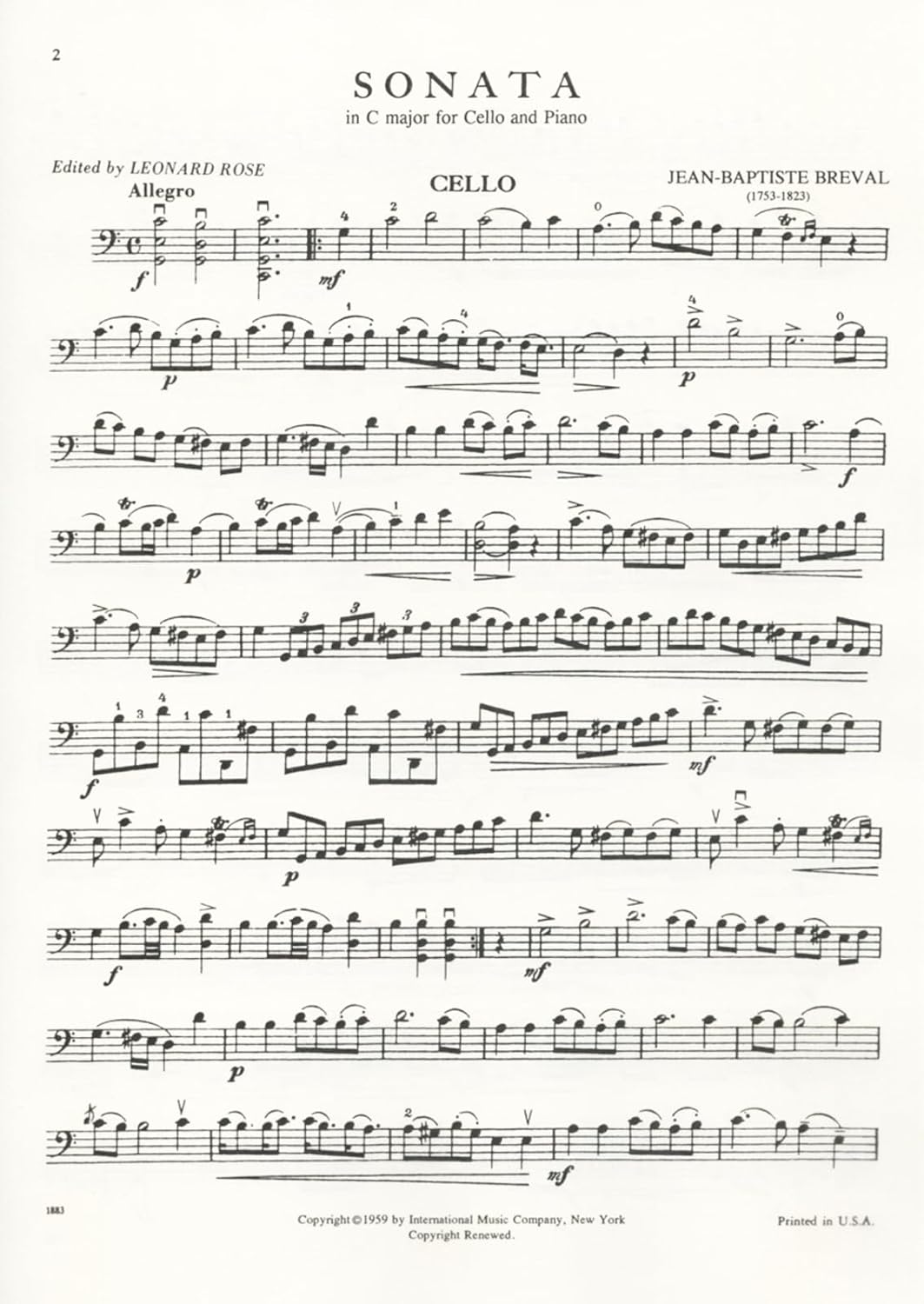
Jean-Baptiste Sebastien Bréval (November 6, 1753 – March 18, 1823) was a French cellist and composer. He wrote mostly pieces for his own instrument, and performed many world premières of his own pieces. He was considered one of the best composers for amateur musicians during his time. Despite this, his works are now rarely performed with the exception of his Cello Sonata in C, Op. 40 (c. 1795).Bréval compositions written between 1775 and 1805 consisted mostly of instrumental pieces. His music reflected the Parisian love for graceful melodies and energetic rhythms. Before 1784 his works were usually two or three movement compositions employing sonata and rondo form, or a one movement work using variations. His later works, such as Symphonie concertante for clarinet, horn and bassoon, Op. 38 (c1795), show diversity and experimentation. His concertos, written for his own performance, were influenced by Giovanni Battista Viotti who utilized a precise thematic organization interjected with virtuosic passages. Bréval is most well-known for his Sonata in C major Op. 40, No. 1, which is one of the classics of student cello literature, and often one of the first full sonatas a cello student will learn. The original version is available from several different publishers. Versions have also been published transcribed for other string instruments, including the viola, and for bass clarinet. Bréval wrote symphonies, seven cello concerti, 4 cello sonatas, various chamber music including five sets of cello duets, as well as a comic opera. Perhaps his most important and influential work was Traité du Violoncelle (1804), a cello method. It was probably the first systematic treatise on the cello. However, it was not well-received as it overlooked the increasing technical advances in the design of the cello that allowed for greater virtuosity on the instrument. Read more
Gospel


![100 Gospel Favorites for Guitar [Print Replica] Kindle Edition](https://m.media-amazon.com/images/I/61CHfoCoyCL._SL1000_.jpg)

![Deluxe Gospel Banjo Songbook [Print Replica] Kindle Edition](https://m.media-amazon.com/images/I/61f1o5IhUVL._SL1000_.jpg)
Cellos



Correction of product information
If you notice any omissions or errors in the product information on this page, please use the correction request form below.
Correction Request Form